Does your dog develop frequent ear infections? Unfortunately, this is a big problem for some pets, and can cause chronic pain for them (which can lead to increasing difficulties if they start to become sensitive about having their ears handled) and significant frustration and cost for their owners.
Fortunately, there’s more we can offer to help manage these issues in the longer term.
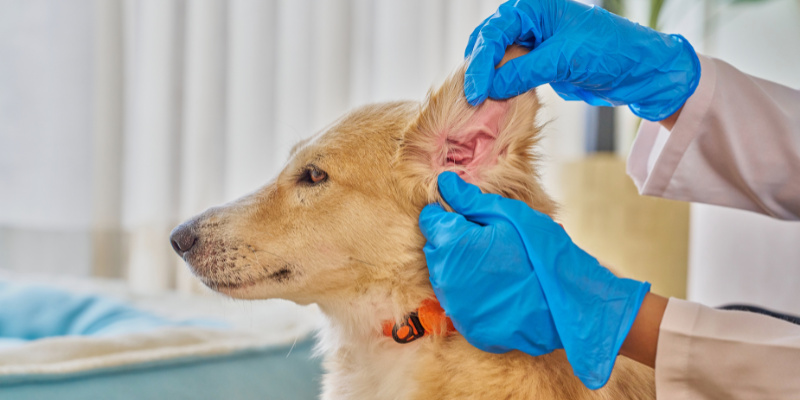
The first step for managing problematic ears is treating any active infection. This involves our vets taking a sample of your dog’s ear discharge for examination under the microscope, so we can check whether they have a yeast overgrowth, a bacterial overgrowth, or a combination of both. We can then pick targeted ear treatments to clear the infection. We may also need to prescribe a course of steroids to help settle down your pet’s ear inflammation and pain, which helps to:
- Make your dog more comfortable and amenable to any handling of their ears
- Open up their ear canals for easier examination, cleaning and topical treatments
Some dogs can be treated with “off-the-shelf” ear ointments, while others may require specially compounded ear medications or oral medications if they have a particularly nasty infection or if we suspect that their ear drum has been damaged.
Depending on the severity of your pet’s current infection, they may require one or several rechecks to confirm resolution. To achieve better ongoing control of your dog’s ear issues (i.e. minimising future flare-ups), our vets will also discuss longer-term management options with you. These include:
-
Hypoallergenic dietary trials
In many cases, recurrent ear infections have an underlying allergic trigger, one of which could be a food allergy – a developed allergy to certain proteins such as beef, chicken, dairy or wheat.
As part of an allergy assessment for your pet, we will often recommend a strict, veterinary-supervised hypoallergenic dietary trial, to see if fully eliminating the protein types that your pet has previously been eating leads to an improvement. Ideally, we then reintroduce these proteins in a staged fashion to confirm which one is the troublemaker.
-
Medical management
If your pet doesn’t improve sufficiently with a hypoallergenic dietary trial, we will then consider potential atopy – an allergy to airborne particles such as tree or grass pollens, mould spores or dust mites.
Management of atopy can involve either long-term medications to help control your pet’s inflammatory response, or referral to a specialist dermatologist for potential immunotherapy (allergy “vaccines” to help reduce your pet’s allergic response in the long term).
-
Flushing under general anaesthetic
Chronically or severely infected ears can become clogged with discharge. If not cleared, this debris can prevent topical ear treatments from working effectively.
In some cases, we may recommend a procedure under anaesthesia to properly clean out your pet’s ears and check their ear drums for infection-related damage.
-
Surgical treatment
Ear canals that have become irreparably damaged, thickened and blocked from recurrent infections may sometimes require surgery to open them up again, so they can aerate properly. This is a significant surgery with potential risks including nerve damage, but can be positively life-changing in pets who need it.
The bottom line? If your pet suffers from frequent ear problems, reach out to our vets to discuss long-term solutions.